Rust, what a streamer server looks like from the inside
You can order the same kind of articles for your own video to boost it on YouTube and Google. Just message the Telegram bot @sat_sit_bot. The bot writes and publishes the articles itself (with your YouTube video embedded) on popular topical websites (no ads). Your first 50 articles are free.
· based on the channel Stimpee
Rust is a multiplayer survival game from Facepunch Studios in which players gather wood, stone and metal, build bases, craft weapons and raid each other on servers that wipe periodically. Streamer servers are a separate ecosystem: private, invite-only worlds where content creators play together, usually with roleplay rules layered on top of the normal survival loop. Stimpee's return to one of these servers after several years away, documented in his video "Not Another Rust Streamer Server", is a useful case study in how that ecosystem works — and how quickly it breaks down when a troll joins a roleplay party. His live streams are on Twitch.
What Rust actually is and why servers matter
Rust is a first-person survival sandbox where progression runs through farming, crafting and base building, and where the biggest threat is usually another player. A fresh wipe resets the map, so everyone starts with a rock and a torch and races to secure a base before nightfall. Wood and stone come first, metal and components later, and every base is a promise that someone will eventually try to break in.
Server type changes the experience more than any patch:
- Official and community servers run the standard loop — solo players, clans, offline raids, roof campers and hackers all in the same pool.
- Roleplay and streamer servers add rules about who can kill whom, when raiding is allowed, and what counts as fair play.
- Wipe schedules determine how long a base is worth defending; a weekly wipe rewards aggression, a monthly wipe rewards patience.
The core tension is that Rust's mechanics reward betrayal and opportunism, while a roleplay server's rules assume cooperation. That mismatch is where most of the entertainment comes from.
How a Rust streamer server like Rust Isles is set up
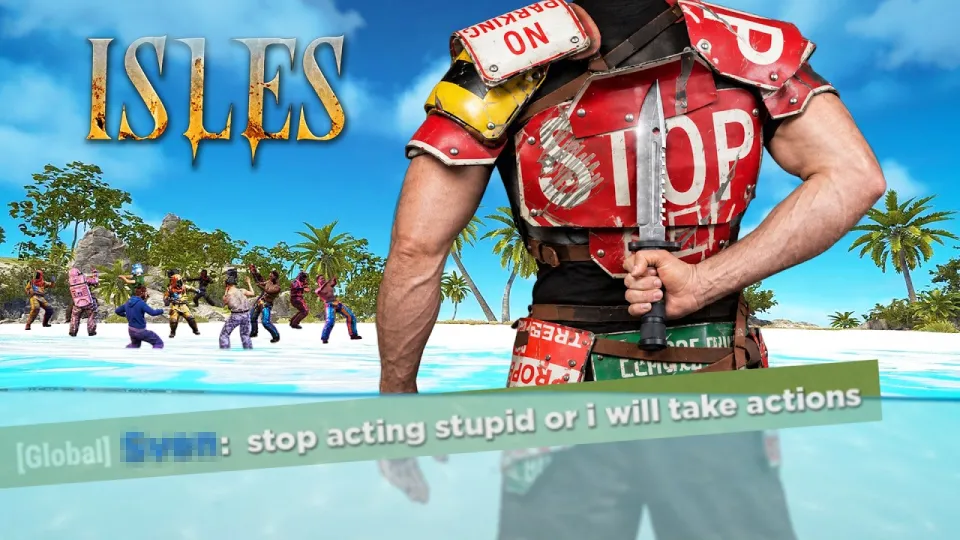
A streamer server is a private Rust world created for content creators, usually with an application or invite process and a team of admins watching chat and the map. Rust Isles, the server Stimpee was given access to, leans into a pirate theme: crews, boats, island bases and a roleplay framing rather than a pure kill-on-sight deathmatch. Access is the whole point — being invited is a status signal in the creator community, and the audience reads it that way.
The practical differences from a public server are significant:
- Population is small and mostly known to each other, so reputations carry between sessions.
- Admins intervene directly, including checking inventories and removing items when someone pushes the chaos too far.
- Sessions are scheduled around streams, so activity spikes when specific creators go live.
- Roleplay expectations replace the usual free-for-all, and breaking character is treated as a social offence rather than a gameplay one.
That structure produces a strange hybrid: Rust's harsh survival systems still apply, but the social layer is closer to a party than a wasteland.
Why Stimpee is treated as a threat on sight
Stimpee has a long reputation in Rust for trolling, trap bases and generally treating other players' plans as raw material, so admins and clan leaders track him the moment he appears at a gathering. In the video that reputation plays out immediately: he is watched, his inventory is checked, and weapons are stripped from him to prevent exactly the kind of mass destruction he is known for. The audience reaction frames it as a compliment — being pre-emptively nerfed is a kind of honour.
The dynamic is worth understanding because it explains most of the drama:
- A streamer server runs on trust that everyone will play along with the premise.
- A troll's value as content comes precisely from not playing along.
- Admins therefore have to choose between enforcing the rules and letting the chaos generate clips.
Rust's own systems make this worse. Boats, explosives and base ownership all create opportunities for theft and betrayal that a roleplay framework has no clean answer for. When a crew leader recruits someone without asking questions and then reacts badly to being robbed, the server's rules and the game's rules are in direct conflict.
The clan, the boat and the limits of roleplay
Clans on streamer servers function like small companies: a leader recruits, assigns roles and expects loyalty in exchange for protection and shared loot. In the video, a crew leader brings Stimpee in with no vetting, and the arrangement collapses when Stimpee takes the boat and leaves the rest of the crew stranded on an island. The leader's reaction — public complaints and lingering resentment — shows where roleplay servers draw their real line.
Stealing a boat is legitimate Rust gameplay; on a pirate-themed server it is also thematically perfect. But the same act violates the social contract of a clan, and the server has no mechanical way to resolve that. The result is a scene that reads as a tantrum rather than a story beat, and it exposes a structural weakness: roleplay servers depend on players choosing to lose gracefully, which is not a skill Rust teaches.
Common questions about streamer servers and Rust etiquette
Viewers watching these servers tend to raise the same doubts, and they are worth answering directly because they explain why the format looks so odd from outside.
- Is this still Rust? The mechanics are unchanged — farming, building, raiding, wipes — but the social rules are invented by the server, so the game feels like a crossover between survival and a chat lobby.
- Why do adults sound like children? Voice chat on a private server is a performance space; people play characters, and the register shifts accordingly.
- Why do admins micromanage? Because a single player with explosives can end a scheduled stream session for everyone else, so intervention is cheaper than a ruined event.
- Is Stimpee actually the problem? On a server built around cooperation, the player who refuses to cooperate is the problem by definition — which is also why he is invited.
The recurring viewer read is that streamer servers resemble being invited to a children's birthday party as an adult with no children: you are technically welcome, but the rules of the room were not written with you in mind.
Useful links
- Stimpee on Twitch — live Rust streams and streamer-server sessions.
- Stimpee on Twitter — schedule and announcements.
- Stimpee on Instagram — clips and behind-the-scenes posts.
- Stimpee's Discord — community chat and session coordination.
What this streamer server episode shows about Rust
Rust streamer servers work as long as everyone agrees to lose in character, and Stimpee's visit to Rust Isles is a stress test of that agreement. The gameplay is standard Rust — boats, bases, stolen loot, stripped inventories — but the friction comes from a private server trying to enforce cooperation inside a game designed around betrayal. The admins' pre-emptive inventory checks and the clan leader's meltdown are both symptoms of the same problem: the format's entertainment value and its rules pull in opposite directions. Stimpee's channel is the author of this breakdown and the source of the session; follow the live streams at twitch.tv/st1mpee to see how the next invite plays out.
Key takeaways
- Rust is a survival game by Facepunch where players farm wood, stone and metal, build bases and raid each other on wipe cycles.
- Streamer servers such as Rust Isles are private, invite-only worlds where content creators roleplay instead of playing the standard public wipe.
- Stimpee returned to a Rust streamer server after years away and was invited to Rust Isles, a pirate-themed roleplay server.
- Admins on such servers police behaviour directly — including removing weapons from a player's inventory to keep the peace.
- Clan leaders on roleplay servers expect loyalty, so stealing a boat or betraying a crew can cause more drama than the raid itself.
Questions & answers
What is a Rust streamer server?
It is a private, usually invite-only Rust world created for content creators, often with roleplay rules and active admins. Population is small and players know each other, so reputation matters more than on a public wipe. Rust Isles, the server in Stimpee's video, uses a pirate theme with crews and boats.
Why did admins remove Stimpee's weapons?
Because a single player with explosives or heavy gear can end a scheduled session for everyone else on a small server. Admins on streamer servers routinely check inventories to prevent that, and Stimpee's known reputation for trolling made him an obvious target for pre-emptive moderation.
Is stealing a boat against the rules on a roleplay server?
Mechanically it is normal Rust gameplay and fits a pirate theme, but it breaks the social contract of a clan that recruited the player expecting loyalty. Roleplay servers have no clean mechanical answer for betrayal, which is why the conflict turns into public drama rather than a resolved in-game event.
Can solo players enjoy Rust without a streamer server?
Yes — solo play on standard community or official servers is the normal Rust experience, built around farming, base design and avoiding or outplaying larger groups. Streamer servers are an entertainment format with modified social rules, not a better version of the base game.